MVHR vs MEV vs PIV: The Complete UK Ventilation Guide for 2026
MVHR vs MEV vs PIV: Which Ventilation System Is Right for Your Home?
If you’re dealing with condensation, mould, stuffy air, or simply trying to work out what Building Regulations expect from your new build or renovation, you’ve probably stumbled across three acronyms: MVHR, MEV, and PIV. They all promise better indoor air, but they work in completely different ways—and the right choice depends on your home, your budget, and what you’re actually trying to achieve.
After over 21 years installing and servicing ventilation systems across Sussex, I’ve seen what works, what fails, and what homeowners wish they’d chosen differently. This guide is everything I’d tell you over a cup of tea if you asked me which system to go for.
A Brief History: How We Got Here
The Problem That Wouldn’t Go Away
For most of human history, buildings ventilated themselves. Draughty windows, open fires drawing air through gaps, chimneys acting as natural extract fans—homes “breathed” without anyone thinking about it. The air quality wasn’t always great (coal smoke, anyone?), but moisture rarely built up long enough to cause serious problems.
Then came the energy crisis of the 1970s. When oil prices quadrupled overnight in 1973, governments across Europe began pushing for better insulation and draught-proofing. The UK introduced its first meaningful insulation standards, and homeowners started sealing up those draughty windows with double glazing, cavity wall insulation, and loft rolls.
The result? Warmer homes—but also homes that could no longer breathe. Within a decade, condensation and mould became epidemic. The same insulation that kept heat in also trapped moisture from cooking, bathing, drying clothes, and simply breathing. A family of four produces roughly 10-14 litres of moisture every single day just through normal living. That moisture has to go somewhere.
The Swedish Connection: Where MVHR Began
Sweden, with its brutally cold winters and progressive building standards, was the first country to face this problem head-on. In the late 1970s and early 1980s, Swedish engineers developed the first practical heat recovery ventilation systems. The concept was elegantly simple: extract stale, humid air from the kitchen and bathroom, pass it through a heat exchanger where it warms the incoming fresh air, and distribute that pre-warmed fresh air to bedrooms and living rooms.
The breakthrough was the counter-flow heat exchanger—a device with no moving parts beyond the fans, where outgoing warm air passes alongside incoming cold air through thin plates or membranes. Heat transfers across, but the air streams never mix. Early units recovered around 50-60% of the heat. Modern systems push that to 90-95%.
By the mid-1980s, MVHR (Mechanical Ventilation with Heat Recovery) was standard in Scandinavian new builds. Germany’s Passivhaus movement, which began in 1988 with physicist Wolfgang Feist, made MVHR a cornerstone of ultra-low-energy building design. Today, you simply cannot build a certified Passivhaus without one.
MEV: The Simpler British Approach
Britain, with its milder (if damper) climate and older housing stock, took a different path. Rather than investing in full ducted heat recovery, developers favoured MEV—Mechanical Extract Ventilation. This was essentially a more sophisticated version of the bathroom extractor fan: a central unit, usually in the loft, continuously extracts stale air from wet rooms (bathrooms, kitchens, utilities) through small ducts.
MEV first appeared in UK Building Regulations in the early 2000s as an approved method for meeting Part F (ventilation) requirements. It was cheaper than MVHR, simpler to install, and didn’t require supply ducting—fresh air entered through trickle vents in windows, just as it always had.
The trade-off? No heat recovery. Every cubic metre of warm air extracted is replaced by cold air seeping in through those trickle vents. In an energy-efficient home, that’s a significant heat loss. But for Britain’s enormous stock of older, naturally leaky properties, MEV offered a pragmatic middle ground.
PIV: A Uniquely British Invention
PIV—Positive Input Ventilation—is arguably the most British of the three systems, born from a very British problem: damp Victorian terraces.
The concept emerged in the early 1990s, pioneered by companies like Nuaire in Wales and EnviroVent in Yorkshire. The idea was beautifully simple: mount a fan unit in the loft, draw air from the loft space (which in most UK homes is cool, dry, and relatively clean), gently filter it, and push it down into the home through a ceiling diffuser, usually on the landing.
This creates a slight positive pressure inside the house—hence the name. Moist, stale air is displaced outwards through natural leakage points: gaps around windows, doors, letterboxes, and the general porousness of older masonry construction. No extract ducting, no trickle vents needed, no heat exchanger. Just a fan, a filter, and gravity.
PIV was revolutionary for the social housing sector. Local authorities dealing with thousands of damp, mouldy council homes could install a PIV unit in an afternoon for a few hundred pounds. It wouldn’t win any awards for energy efficiency, but it would stop the black mould on Mrs. Patterson’s bedroom wall within weeks.
How Each System Actually Works
MVHR: The Complete System
MVHR (Mechanical Ventilation with Heat Recovery) is the most comprehensive of the three. Here’s the full picture:
Supply and extract. MVHR provides balanced ventilation—it simultaneously extracts stale air from wet rooms (kitchen, bathroom, utility, en-suite) and supplies fresh, filtered air to habitable rooms (bedrooms, living rooms, studies). Two separate duct networks run from a central unit, typically installed in a loft, utility room, or cupboard.
Heat recovery. The magic happens in the heat exchanger at the heart of the unit. Outgoing warm air passes through one side of a counter-flow or cross-flow exchanger, transferring its heat to the incoming cold air on the other side. The two air streams never mix—so smells, moisture, and pollutants from the extract air don’t contaminate the supply. Modern units recover up to 90-95% of the heat that would otherwise be lost.
Filtration. Incoming air passes through filters—typically F7 grade or better—which capture pollen, fine dust, diesel particulates, and other pollutants. This makes MVHR particularly valuable for allergy and asthma sufferers. Some units also offer activated carbon filters for odour removal.
Summer bypass. Most quality MVHR units include a summer bypass function. When outdoor temperatures rise above a set point and the house doesn’t need heating, the heat exchanger is automatically bypassed—cool night air flows straight in without being warmed, providing free cooling.
What it costs:
- Installation: £4,000–£8,000 for a typical 3-4 bed house
- Running cost: £40–£60 per year (about 30-50W continuous)
- Filter replacement: £15–£30 per set, every 6-12 months
- Annual service: from £95 with our maintenance packages
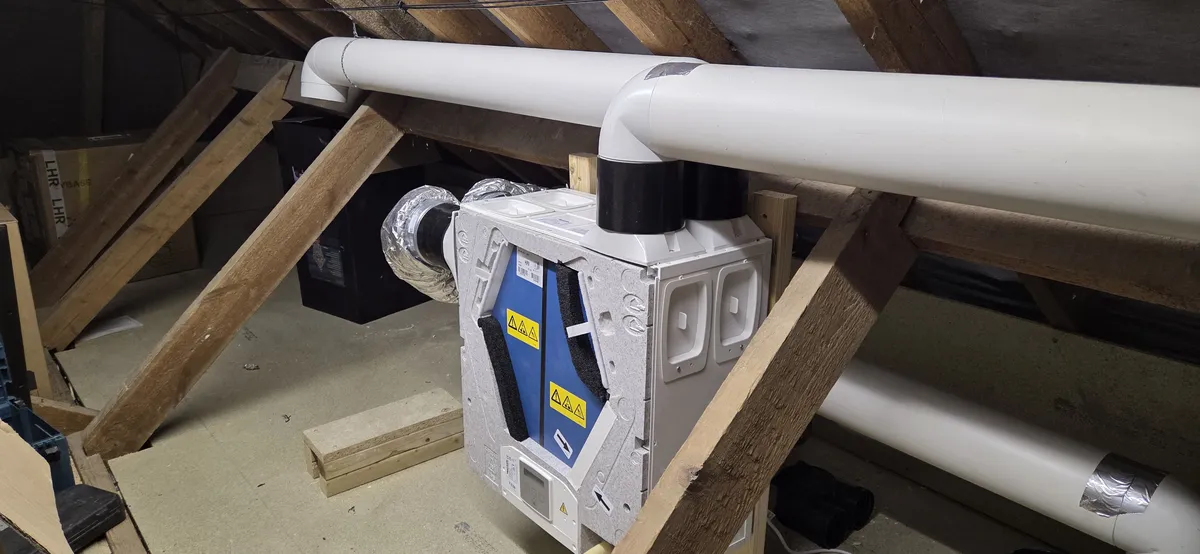 *A Vent-Axia MVHR unit installed in a loft in Small Dole, Sussex — the unit sits neatly between the roof timbers with rigid ducting running to each room.*
MEV: Extract Only
MEV keeps things simpler. A central fan unit—usually a compact box in the loft—connects via small-bore ducting (typically 75mm or 100mm) to extract valves in wet rooms. That’s it for the mechanical side.
Continuous low-speed extraction. Unlike an intermittent bathroom fan that only runs when you flick a switch, MEV runs 24/7 at a low trickle rate. This provides constant background ventilation that prevents moisture building up. Most units have a boost mode triggered by a pull-cord switch, humidity sensor, or CO₂ sensor for higher extraction during cooking or bathing.
Replacement air via trickle vents. Here’s the trade-off. The fresh air that replaces the extracted air comes in through trickle vents—small slots usually built into window frames. This air is untreated: unfiltered, unheated, and at whatever temperature it happens to be outside. On a January morning in Sussex, that’s about 3-5°C.
No heat recovery. Every bit of warmth in the extracted air is dumped outside. In a well-insulated home that’s losing very little heat through walls and windows, ventilation heat loss becomes the dominant energy penalty—and MEV does nothing to address it.
What it costs:
- Installation: £1,000–£2,500
- Running cost: £20–£40 per year (about 10-20W continuous)
- Maintenance: Clean extract valves annually, service unit every 2-3 years
PIV: Positive Pressure
PIV takes the opposite approach to MEV. Instead of extracting air out, it pushes air in.
Loft-mounted fan unit. A compact unit sits in the loft, drawing air from the loft space through a filter. This air is then pushed down through a ceiling-mounted diffuser (usually a circular grille on the landing ceiling) into the living space.
Positive pressure displacement. The gentle positive pressure created inside the home forces stale, moisture-laden air out through the building’s natural leakage points. In an older property with plenty of gaps and cracks, this works remarkably well. The incoming air dilutes the moisture, raises the dew point away from cold surfaces, and displaces the dampest air outwards.
Loft air—is it clean? This is the question everyone asks. In most UK homes, loft air is actually surprisingly clean and dry. It’s been filtered by passing through the roof tiles and felt, it’s at a consistent cool temperature (warmer than outside in winter, cooler than outside in summer), and it has very low humidity. Some PIV units include a small heater element (typically 500W) that tempers the air slightly on the coldest days to avoid cold draughts.
The catch: airtight homes. PIV relies on the building being leaky enough for the pressurised air to escape. In a modern, airtight new build with an air permeability of 3-5 m³/hr/m² at 50Pa, there simply aren’t enough gaps for PIV to work effectively. The positive pressure builds up, the unit stalls against back-pressure, and ventilation rates plummet. This is why PIV is rarely specified in new builds and won’t satisfy Building Regulations for airtight construction.
What it costs:
- Installation: £500–£1,500
- Running cost: £20–£40 per year (about 10-25W plus heater element when active)
- Filter replacement: £10–£20, every 6-12 months
The UK Climate Factor
Why Britain’s Weather Makes This Decision Harder
The UK sits in one of the most challenging climate zones for buildings anywhere in the developed world. We don’t get the reliable cold of Scandinavia (where MVHR is a no-brainer), nor the reliable warmth of southern Europe (where ventilation is mostly about cooling). Instead, we get:
Mild, damp winters. Average winter temperatures in Sussex hover around 4-7°C—not cold enough to drive dramatic heat recovery savings, but cold enough that unheated replacement air (via MEV trickle vents or PIV) feels uncomfortable. More importantly, our winter relative humidity regularly exceeds 85-90%, meaning the air coming in through trickle vents is already moisture-laden.
Unpredictable springs and autumns. The “shoulder seasons” in the UK can swing from 5°C to 18°C in a single week. Buildings with poor ventilation accumulate moisture during the damp spells, then struggle to dry out during the brief warm windows. This is when condensation damage typically accelerates—those weeks in October and March when you stop opening windows but haven’t turned the heating on properly yet.
Coastal exposure. Along the Sussex coast—Brighton, Hove, Worthing, Shoreham, Lancing—salt air adds another dimension. Higher absolute humidity from the sea, salt deposits that corrode equipment, and prevailing southwesterly winds that drive rain against facades all contribute to more demanding ventilation requirements.
The “British heating pattern.” Unlike Scandinavian countries where homes maintain a steady 20-22°C throughout winter, British homes tend to heat intermittently—blasting the central heating morning and evening, then letting the house cool during the day and overnight. This temperature cycling creates condensation risk on cold surfaces every time the heating switches off and temperatures drop.
Seasonal Ventilation Demands
| Season | Challenge | MVHR | MEV | PIV |
|---|---|---|---|---|
| Winter | Cold, damp outside air. Heating cost matters. | Excellent—recovers heat, filters cold air, controls humidity | Poor—cold air enters via trickle vents, no heat recovery | Moderate—loft air is warmer than outside but still cool |
| Spring | Temperature swings, intermittent rain, pollen season | Excellent—filters pollen, adapts to temperature changes | Adequate—removes moisture but no filtration | Good—some filtration of incoming air |
| Summer | Overheating risk, need for cooling, hay fever | Good—bypass mode provides free cooling, continues filtering | Adequate—continues extracting but minimal benefit | Poor—can push hot loft air into already warm rooms |
| Autumn | Rising humidity, decreasing temperatures, condensation onset | Excellent—manages the transition period automatically | Adequate—prevents worst condensation if running properly | Good—effective at displacing damp air in leaky homes |
Building Regulations: What the Law Actually Requires
Approved Document F (2021 Edition)
The current version of Part F, which came into force in June 2022, sets out ventilation requirements for all dwellings in England. It’s more demanding than previous versions and explicitly favours continuous ventilation over intermittent approaches.
System 1: Background ventilators plus intermittent extract fans. The most basic approach—trickle vents and bathroom fans. Still technically compliant but increasingly inadequate for modern, well-insulated homes.
System 2: Passive stack ventilation. Uses natural buoyancy (warm air rises) to ventilate through vertical ducts. Rarely seen in new construction due to unpredictable performance.
System 3: Continuous MEV. A central extract fan running continuously with trickle vents for replacement air. Meets Part F requirements and is the minimum many developers specify in new builds.
System 4: Continuous MVHR. Balanced supply and extract with heat recovery. Meets both Part F (ventilation) and supports Part L (energy efficiency) compliance. Increasingly specified as airtightness standards tighten.
Where does PIV fit? Here’s the honest truth: PIV is not listed as a standalone ventilation strategy in Approved Document F for new builds. It can be used as a supplementary measure—to combat condensation in existing homes, for example—but it doesn’t meet the regulatory framework for new construction. This matters if you’re planning a new build or major renovation that triggers Building Regulations.
Part L and the Airtightness Connection
Part L (Conservation of Fuel and Power) has been progressively tightening airtightness standards. The 2021 update requires new homes to achieve air permeability no greater than 8 m³/hr/m² at 50Pa, with most achieving 3-5 m³/hr/m² in practice. The upcoming Future Homes Standard (from 2025) will push this further.
Why this matters for your ventilation choice:
- At 8-10 m³/hr/m² (typical older property after some improvement): PIV works well, MEV is adequate, MVHR offers comfort and efficiency benefits
- At 5-8 m³/hr/m² (typical new build): PIV becomes less effective, MEV works but wastes heat, MVHR starts making strong economic sense
- At 3-5 m³/hr/m² (well-built new home): PIV doesn’t work reliably, MEV wastes significant heat, MVHR is the only sensible choice
- Below 3 m³/hr/m² (Passivhaus territory): MVHR is essential, nothing else will work
SAP Calculations and Energy Ratings
When calculating a new home’s energy performance for an EPC (Energy Performance Certificate), the SAP methodology credits MVHR with significant energy savings. A home with MVHR will typically score 5-10 SAP points higher than the same home with MEV, which can make the difference between a B and C rating—or help developers meet the Target Emission Rate without expensive upgrades elsewhere.
Building Types: What Works Where
Victorian and Edwardian Terraces (Pre-1919)
These make up a huge proportion of Sussex’s housing stock—the rows of bay-fronted terraces across Brighton, Hove, and Worthing. They share common characteristics:
- Solid brick walls (no cavity), typically 225mm or 350mm thick
- Suspended timber floors with airbricks below
- Sash windows (often now double-glazed replacements)
- High ceilings (2.7-3m), large rooms
- Naturally draughty with air permeability typically 12-20 m³/hr/m²
Best choice: PIV or MEV. These houses leak like sieves, which is actually an advantage for PIV—there are plenty of escape routes for the pressurised air. A PIV unit in the loft will often transform a damp Victorian terrace within weeks. MEV is also effective here, as the natural leakiness provides ample replacement air.
MVHR consideration: Retrofitting MVHR into a Victorian terrace is possible but expensive—running supply and extract ducting through narrow ceiling voids and period features is complex. Unless the house has been comprehensively insulated and sealed (internal wall insulation, new airtight windows, sealed floors), the heat recovery benefit won’t justify the cost because the house is losing heat through the fabric faster than MVHR can save it.
1930s Semi-Detached Houses
The classic inter-war semi—cavity walls (often now insulated), bay windows, suspended timber ground floors, concrete first floors. Very common across Shoreham, Lancing, Southwick, and inland Sussex.
- Cavity walls (50-75mm cavity), often with retrospective blown insulation
- Suspended timber ground floor over a ventilated void
- Mix of original and replacement windows
- Moderate airtightness (8-15 m³/hr/m²)
Best choice: PIV or MEV, with MVHR worth considering if you’re doing a deep retrofit. The 1930s semi sits in an interesting middle ground. PIV works well for condensation control. MEV provides reliable extraction. But if you’re already upgrading insulation, replacing windows, and improving airtightness, this is the point where MVHR starts making real sense—the house is tight enough for heat recovery to matter, but the fabric improvements have reduced other heat losses so ventilation becomes a bigger proportion.
Post-War Council Housing and Bungalows
Sussex has large estates of 1950s-1970s council housing, including many bungalows in areas like Portslade, Lancing, and the outskirts of Worthing. These have their own quirks:
- Solid concrete floors (no suspended timber)—cold, prone to edge condensation
- Flat or low-pitch roofs on some bungalows—limited loft space for equipment
- Concrete block or no-fines concrete walls
- Often on exposed, elevated sites catching prevailing weather
- Single-storey bungalows have different airflow patterns to two-storey houses
Best choice: Depends on roof type. For bungalows with adequate loft space, PIV is often the quickest win for condensation problems—particularly effective with solid concrete floors where cold-bridging at the floor-wall junction causes persistent damp. For flat-roofed bungalows or those with minimal loft space, wall-mounted dMEV or dMVHR units in problem rooms are a better bet. Full MVHR requires enough ceiling void to run ducting, which bungalows sometimes lack.
The solid floor problem: Solid concrete ground floors are significantly colder than suspended timber floors in winter, because they conduct heat into the ground. This creates condensation risk along skirting boards, behind furniture pushed against external walls, and in corners. PIV helps by raising the dew point temperature inside the room—but it won’t fix a floor that’s losing heat. Insulating the floor perimeter (with rigid insulation board against the wall base) combined with PIV or MEV is the proper solution.
Modern New Builds (Post-2006)
Any home built to modern Building Regulations—typically with cavity walls, insulated concrete floors, double or triple glazing, and designed airtightness—is a fundamentally different proposition.
- Airtightness of 3-8 m³/hr/m² (and getting tighter with each regulation update)
- Insulated throughout—walls, floors, roofs all meeting current U-value requirements
- Controlled ventilation is not optional—these houses cannot rely on accidental air leakage
Best choice: MVHR. For any new build with reasonable airtightness, MVHR is the right answer. The house is tight enough for heat recovery to deliver meaningful energy savings, the construction phase allows ducting to be installed easily, and Building Regulations effectively nudge designers toward System 4 (MVHR) as Part L gets tighter.
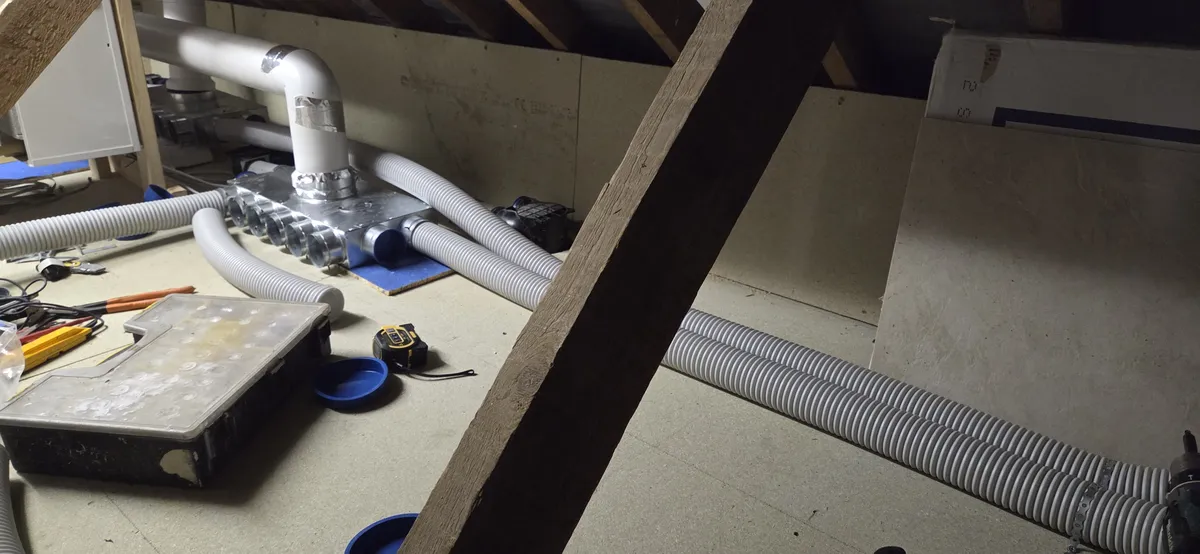 *75mm semi-rigid ducting routed through the ceiling to a bedroom outlet — once the ceiling is finished, only a small discreet grille is visible in the room.*
We’ve seen the problems that arise when developers install MEV in modern airtight homes to save money—inadequate ventilation, condensation, mould, and unhappy homeowners. Don’t let a builder cut this corner.
Sussex Coastal Properties
The Sussex coast presents specific challenges regardless of building age:
- Higher humidity from marine air (typically 5-10% higher RH than 10 miles inland)
- Salt corrosion of external components and fixings
- Wind-driven rain requiring careful detail design of external grilles and wall penetrations
- Exposed sites where wind noise through trickle vents can be problematic
For coastal properties, MVHR has an additional advantage: it’s a sealed system. External air enters through a single, properly detailed intake with filters and weatherproofing. With MEV and trickle vents, every window becomes a potential entry point for salt-laden, damp air—and you have no filtration. PIV draws from the loft, which at least provides some natural filtration, but salt deposits can still accumulate.
Real Numbers: The Honest Cost Comparison
Let’s look at a typical 3-bedroom semi-detached house in Sussex over a 15-year period:
Upfront Costs
| MVHR | MEV | PIV | |
|---|---|---|---|
| Equipment | £2,000–£3,500 | £400–£800 | £300–£600 |
| Installation labour | £2,000–£4,500 | £600–£1,700 | £200–£900 |
| Total installed | £4,000–£8,000 | £1,000–£2,500 | £500–£1,500 |
Annual Running Costs
| MVHR | MEV | PIV | |
|---|---|---|---|
| Electricity | £40–£60 | £20–£40 | £20–£40 |
| Filters | £20–£30 | £0 | £10–£20 |
| Servicing | £95–£300 | £0–£60 | £0–£40 |
| Annual total | £155–£390 | £20–£100 | £30–£100 |
Energy Savings (Heating Bill Reduction)
This is where the real calculation happens:
| MVHR | MEV | PIV | |
|---|---|---|---|
| Heat recovery saving | 15–30% of heating bill | None | None |
| Estimated annual saving | £200–£500 | £0 | £0 |
For a home spending £1,500/year on gas or heat pump heating, MVHR’s heat recovery could save £225–£450 annually. Over 15 years, that’s £3,375–£6,750 in heating savings—often covering the entire installation cost difference.
15-Year Total Cost of Ownership
| MVHR | MEV | PIV | |
|---|---|---|---|
| Installation | £6,000 (mid-range) | £1,750 | £1,000 |
| Running costs (15 years) | £3,000 | £900 | £975 |
| Heating savings (15 years) | -£5,000 | £0 | £0 |
| Net 15-year cost | £4,000 | £2,650 | £1,975 |
The gap is much smaller than the upfront numbers suggest. And MVHR delivers significantly better air quality, filtration, and comfort throughout those 15 years—benefits that don’t have a price tag but dramatically affect quality of life.
Interesting Facts You Probably Didn’t Know
The 10-litre rule. A family of four generates roughly 10-14 litres of moisture per day through breathing, cooking, bathing, and drying clothes. That’s nearly three gallons of water vapour pumped into your home every single day. Without adequate ventilation, that moisture condenses on the coldest surfaces—typically windows, external walls, and cold bridges.
Passivhaus and MVHR. The world’s first certified Passivhaus, built in Darmstadt, Germany in 1991, relied on MVHR as one of its five key principles. Over 30 years later, the original MVHR unit was only recently replaced—testament to the longevity of a well-maintained system.
The UK’s mould epidemic. According to the English Housing Survey, around 4% of English homes—nearly one million properties—have significant damp or mould problems. The figure rises to 9% in the private rented sector. After the tragic death of Awaab Ishak in Rochdale in 2020 from exposure to mould, “Awaab’s Law” now requires social landlords to address damp and mould hazards within strict timescales. Proper ventilation is the most effective long-term solution.
PIV’s unexpected success. Despite being the simplest and cheapest option, PIV has been installed in over 2 million UK homes—more than MVHR and MEV combined. Its popularity in social housing and the private rented sector is driven by speed of installation (often under 2 hours) and immediate, visible results in damp properties.
The German connection. Germany’s KfW energy efficiency standards, which drive much of European building practice, essentially require MVHR in any home receiving energy efficiency subsidies. The UK has no equivalent mandatory requirement, which is one reason our average building ventilation standard lags behind northern European neighbours.
Heat exchanger efficiency has plateaued. Modern counter-flow heat exchangers in premium MVHR units achieve 90-95% thermal efficiency. This is approaching the theoretical maximum—further improvements will come from smarter controls and demand-responsive operation rather than better heat exchangers.
Dew point, not temperature, is what matters. Condensation doesn’t form because it’s cold. It forms when a surface temperature drops below the dew point of the air touching it. A room at 20°C with 70% relative humidity has a dew point of about 14°C. If any surface in that room—a window, a cold wall, a thermal bridge—drops below 14°C, you’ll get condensation. MVHR addresses this by removing moisture at source (lowering dew point) AND pre-warming incoming air (raising surface temperatures). MEV removes moisture but introduces cold air. PIV dilutes moisture but doesn’t remove it.
Common Mistakes I See Every Week
Mistake 1: Choosing PIV for a New Build
I’ve had multiple calls from homeowners in new developments who’ve been sold PIV as a “modern ventilation solution.” The problem? Their house is built to modern airtightness standards—there are no gaps for the pressurised air to escape. The PIV unit runs, the pressure builds up, and the house doesn’t ventilate. Cue condensation, mould, and an angry phone call to the developer.
The fix: Remove the PIV and install either MEV or MVHR. For an airtight home, there’s no shortcut.
Mistake 2: Blocking Trickle Vents with MEV Installed
Homeowners with MEV systems regularly block their trickle vents because “they let the cold in.” They’re right—they do let cold air in. But that’s the only way MEV gets replacement air. Block the trickle vents and you’ve created a negative pressure in the house. Doors become hard to open, extractor fans in the kitchen stop working properly, and—ironically—the house becomes stuffier and damper than before because the MEV can’t pull air through.
The fix: Don’t block the trickle vents. Or better yet, upgrade to MVHR where the supply air comes in pre-warmed and filtered.
Mistake 3: Undersizing MVHR
A frustrating trend in new-build developments: installing the cheapest, smallest MVHR unit that technically meets the minimum airflow requirements on paper. These units run at high speed to deliver the required ventilation rates, creating noise and burning through electricity. A properly sized unit running at low speed is quieter, more efficient, and lasts longer.
The fix: Specify an MVHR unit rated for at least 30% more airflow than your calculated requirement. This allows it to cruise at low speed, barely audible, with headroom for boost mode when needed.
Mistake 4: Installing MEV Without Understanding Your Home
MEV works well in older, leakier homes where replacement air enters naturally. But in a home that’s been retrofitted with internal wall insulation, new sealed windows, and draught-stripped doors, the replacement air path may be compromised. The MEV extracts air, but fresh air can’t easily get in—so it draws from wherever it can: down the chimney (bringing soot and cold), through the loft hatch, or even backwards through the kitchen extract hood.
The fix: If you’ve significantly improved your home’s airtightness, reassess whether MEV still works. You may need additional background ventilators or a step up to MVHR.
Our Honest Recommendation
After installing all three systems in hundreds of Sussex homes, here’s how I’d summarise the decision:
Choose MVHR if:
- You’re building a new home or doing a deep retrofit
- Your home is reasonably airtight (below 8 m³/hr/m² at 50Pa)
- You want the best air quality with filtered, pre-warmed supply air
- Anyone in the household has allergies, asthma, or respiratory conditions
- You want to future-proof—regulations are only getting tighter
- You’re installing air conditioning too (MVHR and AC complement each other perfectly)
Choose MEV if:
- You have an older property with reasonable natural air leakage
- Budget is the primary constraint
- The home will not be significantly sealed or insulated
- You want simple, reliable, low-maintenance ventilation
Choose PIV if:
- You have an older, naturally leaky property with damp or condensation problems
- You need a quick, affordable fix
- The property has a conventional pitched roof with accessible loft space
- You’re a landlord needing rapid condensation solutions across a portfolio
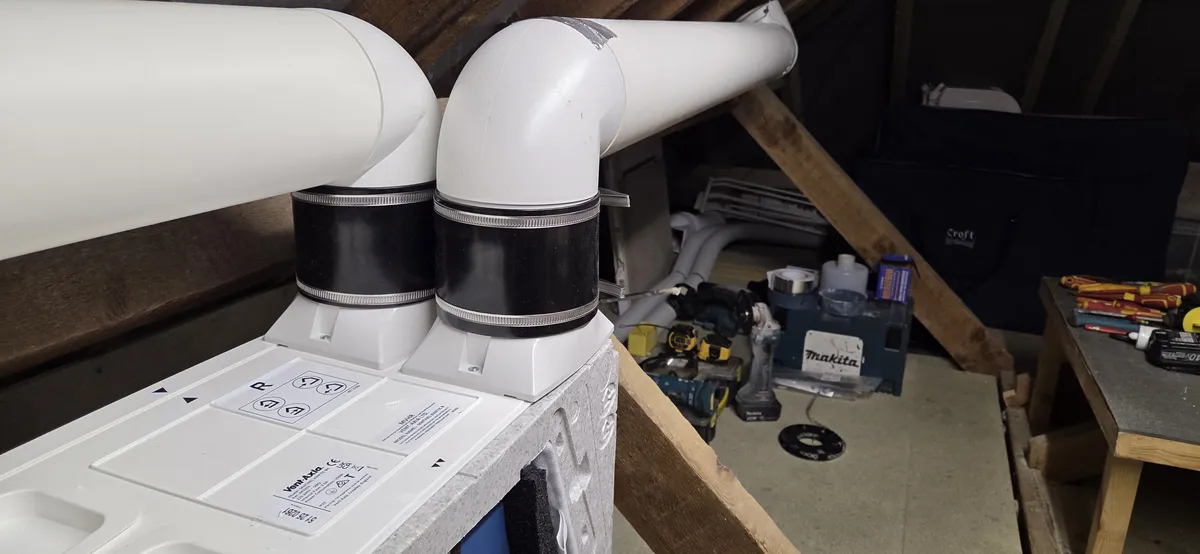 *Properly sealed duct connections on the Vent-Axia unit — airtight joints are critical for system efficiency and noise control.*
The bottom line: For any home built or renovated to modern standards, MVHR is the best long-term investment. The upfront cost is higher, but the combination of heat recovery, air filtration, comfort, and regulatory compliance makes it the only choice that improves with time as energy costs rise and building standards tighten.
For older Sussex homes battling damp and condensation, PIV remains the fastest, most cost-effective intervention. It’s not the most sophisticated solution, but it works—and sometimes “works right now” beats “optimal in five years.”
As NICEIC-certified installers registered on the Competent Persons Scheme, we can self-certify your ventilation installation as Building Regulations Part F compliant — no separate local authority inspection needed.
Frequently Asked Questions
Can I switch from PIV to MVHR later?
Yes, but it’s a bigger job than starting fresh. MVHR requires supply and extract ducting throughout the house, which means routing pipes through ceiling voids, boxing, or risers. If you’re planning a major renovation later, it may be worth running the ducts now and capping them off, then installing the MVHR unit when budget allows.
Does PIV work in a flat?
Generally not well. PIV needs a loft space to draw air from, and flats don’t have that. Wall-mounted dMVHR (decentralised MVHR) units are a much better option for flats—they provide heat recovery ventilation room by room without any loft space.
Will MVHR eliminate condensation completely?
In most cases, yes—if the system is properly designed, installed, and commissioned. MVHR controls both sides of the equation: it removes moisture-laden air from wet rooms AND supplies fresh, drier air to living spaces. However, MVHR won’t fix structural damp (rising damp, penetrating damp from roof leaks, etc.). Those need addressing separately.
Is MVHR noisy?
A well-installed MVHR system should be virtually inaudible. We target 25-30 dB in living spaces—quieter than a library. Noise problems almost always trace back to installation errors: undersized ducts, missing silencers, units mounted without vibration isolation, or systems running too fast because they were undersized. Read about common MVHR noise issues and how we fix them.
Can I install MVHR myself?
The unit itself isn’t hugely complex, but the design and ducting layout absolutely must be done by someone who understands airflow, pressure drops, and building physics. A poorly designed MVHR system—wrong duct sizes, inadequate silencers, unbalanced airflows—will be noisy, inefficient, and may not meet Building Regulations. The commissioning step (measuring and balancing airflows at every terminal) requires specialist equipment and knowledge. This is not a DIY job.
How long does each system last?
- MVHR: 15-25 years for the unit, with fan motors potentially needing replacement at 10-15 years. Heat exchangers last the lifetime of the unit.
- MEV: 10-15 years typical. Fan motors are the most common failure point.
- PIV: 10-15 years. Simple units with fewer components tend to be reliable.
Do any of these systems provide cooling?
MVHR with a summer bypass can provide modest free cooling by channelling cool night air directly into the house. However, none of these systems are air conditioning. For active cooling, you need a separate air conditioning system—which works brilliantly alongside MVHR. The MVHR handles ventilation and air quality; the AC handles temperature. Together, they create a complete indoor climate system.
Not Sure Which System Your Home Needs?
We’ve installed MVHR, MEV, and PIV systems across every type of Sussex property—from Victorian terraces in Brighton to modern eco-builds in Pulborough. We’ll assess your home honestly and recommend the right solution for your property, your budget, and your goals. No hard sell, just straight advice from engineers who’ve been doing this for over 21 years.
See our full MVHR vs MEV vs PIV comparison table for a quick side-by-side breakdown.